
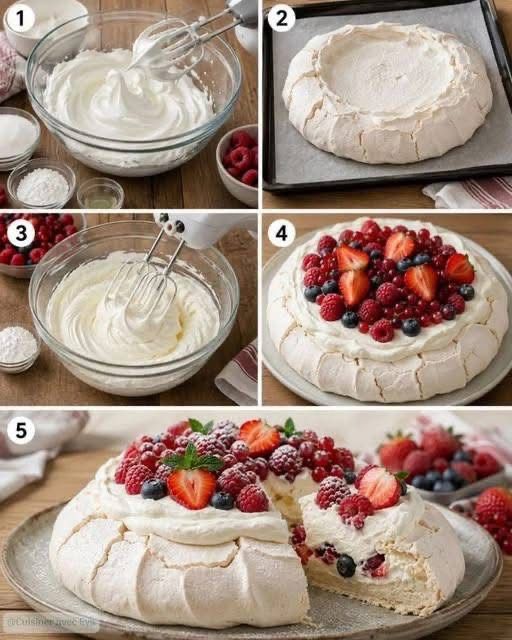
A spectacular summer dessert with a crisp, delicate meringue shell, a soft marshmallow-like center, clouds of lightly sweetened whipped cream, and plenty of fresh seasonal berries. This elegant Pavlova looks impressive but can be made with simple ingredients and straightforward techniques.
Recipe Overview
| Details | Information |
| Prep Time | 25 minutes |
| Cook Time | 90 minutes |
| Cooling Time | 2 hours minimum |
| Total Time | About 3 hours 55 minutes |
| Servings | 8–10 slices |
| Difficulty | Intermediate |
| Cuisine | Australian/New Zealand-inspired |
| Category | Dessert |
| Dietary | Naturally gluten-free |
Why You’ll Love This Recipe
- Crisp and creamy: The outside is delicate and crisp while the center stays soft and marshmallowy.
- Fresh and fruity: Sweet meringue and cream pair beautifully with tart, juicy berries.
- Beautiful presentation: The colorful fruit makes this an impressive centerpiece for parties and celebrations.
- Make-ahead friendly: The meringue shell can be prepared a day or two before serving.
- Naturally gluten-free: No wheat flour is required.
- Perfect for summer: Fresh strawberries, raspberries, blueberries, and currants make this dessert especially refreshing.
Ingredients
For the Meringue
| Ingredient | Quantity | Notes |
| Large egg whites | 4 | At room temperature |
| Caster sugar | 1 cup (200 g) | Superfine sugar is ideal |
| Cornstarch | 1 teaspoon | Helps create the soft center |
| White vinegar or lemon juice | 1 teaspoon | Helps stabilize the meringue |
| Pure vanilla extract | 1 teaspoon | For flavor |
For the Whipped Cream
| Ingredient | Quantity |
| Heavy whipping cream | 1½ cups (360 ml) |
| Powdered sugar | 2 tablespoons |
For the Berry Topping
| Ingredient | Quantity |
| Fresh mixed berries | 3 cups |
| Strawberries | As desired |
| Raspberries | As desired |
| Blueberries | As desired |
| Red currants | As desired |
| Fresh mint leaves | Optional |
Step-by-Step Instructions
1. Prepare the Oven and Baking Sheet
Preheat the oven to 120°C (250°F).
Line a large baking sheet with parchment paper. Using a pencil, trace an approximately 20 cm (8-inch) circle on the underside of the parchment.
Make sure the parchment is completely flat.
2. Whip the Egg Whites
Place the room-temperature egg whites in a completely clean and dry glass or metal mixing bowl.
Using a hand mixer or stand mixer, beat the egg whites on medium speed until they become foamy and form soft peaks.
The bowl and beaters must be free from grease because even a small amount of fat can prevent the egg whites from whipping properly.
3. Gradually Add the Sugar
Increase the mixer to medium-high speed.
Add the caster sugar one tablespoon at a time, allowing roughly 10–15 seconds between additions.
Continue beating until the meringue becomes:
- Thick
- Glossy
- Bright white
- Very stiff
- Smooth rather than gritty
This process may take several minutes.
To check whether the sugar has dissolved, rub a small amount of meringue between your fingertips. It should feel smooth rather than grainy.
4. Add the Cornstarch, Vinegar and Vanilla
Turn off the mixer.
Sprinkle the cornstarch over the meringue and add the vinegar or lemon juice and vanilla extract.
Using a silicone spatula, gently fold everything together until just incorporated.
Avoid excessive mixing because you don’t want to lose the air you’ve incorporated into the egg whites.
5. Shape the Pavlova
Spoon the meringue onto the center of the prepared parchment, using the traced circle as your guide.
Shape it into a round mound approximately 20 cm (8 inches) wide.
Use the back of a spoon or an offset spatula to create slightly raised edges and a shallow indentation in the center.
The center will hold the whipped cream and berries after baking.
Don’t worry about making it perfectly smooth. The rustic appearance is part of the charm of a homemade Pavlova.
6. Bake the Pavlova
Place the baking sheet in the oven.
Immediately reduce the temperature to 105°C (225°F).
Bake for approximately 90 minutes.
Keep the oven door closed during baking.
The Pavlova should feel dry on the outside and may have a few small cracks.
7. Cool Slowly
After 90 minutes, turn off the oven.
Do not remove the Pavlova immediately.
Leave it inside the closed oven for at least 2 hours, preferably until completely cool.
This gradual cooling process helps minimize dramatic cracking and prevents the meringue from collapsing because of a sudden temperature change.
8. Prepare the Whipped Cream
Just before serving, place the cold heavy cream and powdered sugar in a chilled mixing bowl.
Beat on medium speed until the cream forms soft, billowy peaks.
Stop as soon as the cream reaches the desired consistency. Over-whipping can make the cream grainy and eventually turn it into butter.
9. Prepare the Berries
Wash the berries carefully and dry them thoroughly.
Slice the strawberries if they are large.
Try to remove as much excess water as possible because moisture can soften the meringue.
10. Assemble the Pavlova
Carefully transfer the completely cooled Pavlova to a serving plate.
Spoon the whipped cream into the center.
Arrange the strawberries, raspberries, blueberries, and red currants generously over the cream.
Add a few fresh mint leaves if desired.
For the best texture, serve immediately after assembling.
Expert Tips for the Perfect Pavlova
Use Room-Temperature Egg Whites
Room-temperature egg whites generally whip more easily and can produce excellent volume.
Keep Everything Grease-Free
Make sure your bowl, beaters, and utensils are completely clean and dry. A trace of grease can interfere with the egg whites.
Add Sugar Slowly
Adding sugar gradually gives it time to dissolve into the egg whites and helps create a smooth, glossy meringue.
Don’t Open the Oven
Avoid opening the oven during baking and cooling. Sudden temperature changes can encourage cracking and collapsing.
Dry the Fruit
Wet berries introduce extra moisture to the meringue. Pat them dry before decorating.
Assemble at the Last Minute
For the crispest exterior, add the cream and fruit shortly before serving.
Best Ingredient Substitutions
Caster Sugar
If caster sugar isn’t available, regular granulated sugar can be used. For a smoother meringue, pulse the sugar briefly in a food processor to make it finer.
Lemon Juice
White vinegar can replace lemon juice in equal quantities.
Vanilla Extract
Pure vanilla extract can be replaced with vanilla bean paste.
Mixed Berries
Use whichever fresh berries are available. Blackberries, cherries, sliced peaches, or passion fruit can also work beautifully.
Recipe Variations
Tropical Pavlova
Replace the berries with:
- Mango
- Passion fruit
- Kiwi
- Toasted coconut
The tropical fruit provides a bright contrast to the sweet meringue.
Chocolate Pavlova
Add 2–3 tablespoons of sifted unsweetened cocoa powder to the finished meringue and gently fold it in.
Top with whipped cream, raspberries, and chocolate shavings.
Lemon Berry Pavlova
Add a layer of homemade lemon curd underneath the whipped cream for a delicious sweet-and-tart combination.
Mini Pavlovas
Instead of making one large Pavlova, divide the mixture into 6–8 smaller mounds.
Reduce the baking time and monitor them closely because smaller Pavlovas cook faster.
What to Serve With Pavlova
Pavlova is delicious on its own, but several additions can make it even more special.
Try serving it with:
- Lemon curd
- Raspberry coulis
- Passion fruit pulp
- Extra fresh berries
- Vanilla sauce
- Fresh mint
- A cup of freshly brewed coffee
- Tea
The tartness of lemon or berries is especially useful for balancing the sweetness of the meringue.
Make-Ahead Instructions
The meringue shell can be prepared 1–2 days in advance.
Allow it to cool completely, then store it in a dry environment protected from humidity.
Do not add the whipped cream or berries until shortly before serving.
Humidity is one of the biggest enemies of crisp meringue.
Storage
Unassembled Pavlova
Store the cooled meringue in an airtight container at room temperature for up to 2 days, provided the environment is dry.
Assembled Pavlova
Once topped with whipped cream and fresh fruit, refrigerate it and ideally consume it within a few hours.
The moisture from the cream and fruit will gradually soften the meringue.
Reheating
Pavlova does not need to be reheated.
In fact, reheating a finished Pavlova can melt the cream and damage the fruit topping.
If the meringue has softened slightly, it is generally better served as-is rather than reheated.
Freezing
Freezing the finished Pavlova is not recommended because freezing and thawing can negatively affect its delicate texture.
For the best results, prepare the meringue fresh and store it at room temperature before decorating.
Common Mistakes to Avoid
1. Using a Dirty Mixing Bowl
Any grease or fat can prevent the egg whites from reaching their full volume.
2. Adding the Sugar Too Quickly
Adding large amounts of sugar at once can make it difficult for the sugar to dissolve properly.
3. Under-Beating the Meringue
The finished meringue should be glossy and hold firm peaks.
4. Over-Mixing After Adding Cornstarch
Fold gently to avoid deflating the egg whites.
5. Opening the Oven Door
Sudden temperature changes can cause excessive cracking or collapse.
6. Removing the Pavlova Too Quickly
Allow it to cool gradually inside the turned-off oven.
7. Decorating Too Early
Cream and wet fruit will gradually soften the crisp shell, so decorate close to serving time.
Nutrition Estimate
Approximate values per serving, based on 10 servings and excluding optional garnishes:
| Nutrient | Approximate Amount |
| Calories | 240 kcal |
| Total Fat | 13 g |
| Saturated Fat | 8 g |
| Cholesterol | 45 mg |
| Sodium | 35 mg |
| Total Carbohydrates | 30 g |
| Dietary Fiber | 2 g |
| Sugars | 27 g |
| Protein | 3 g |
Nutrition information is an estimate and can vary depending on ingredient brands, portion sizes, and the amount of fruit used.
Frequently Asked Questions
How do I know when the sugar is dissolved?
Rub a small amount of the meringue between your thumb and index finger. If it feels smooth, the sugar is well incorporated. If it feels gritty, continue beating for another minute or two and test again.
Why did my Pavlova crack?
Some cracking is completely normal and is part of Pavlova’s characteristic appearance. Large cracks can be caused by rapid temperature changes, overbaking, or sudden cooling.
Can I make Pavlova in humid weather?
Yes, but humidity makes meringue more difficult because sugar readily absorbs moisture from the air.
Choose the driest conditions possible and keep the finished shell in an airtight container.
Can I use regular sugar instead of caster sugar?
Yes. However, caster sugar dissolves more readily and can produce a smoother meringue.
Why is my Pavlova sticky?
A sticky exterior can result from humidity, insufficient drying, or sugar that hasn’t fully dissolved.
Can I make the Pavlova the day before?
Absolutely. Preparing the meringue shell the day before is an excellent way to reduce preparation time on the day of your event.
Keep the cream and fruit separate until serving.
Why did my Pavlova collapse?
Possible causes include underbaking, opening the oven during baking, excessive mixing, or cooling the Pavlova too quickly.
Final Thoughts
This Classic Summer Berry Pavlova is the perfect combination of textures and flavors: a crisp, delicate shell, a soft marshmallow-like center, silky whipped cream, and juicy fresh berries.
Although Pavlova looks like an elaborate bakery dessert, the technique is surprisingly approachable when you take your time and pay attention to the small details.
For the best results, focus on a clean mixing bowl, slowly incorporate the sugar, bake the meringue gently, and allow it to cool gradually.
Then simply add the whipped cream and colorful berries just before serving for an elegant dessert that’s perfect for summer gatherings, birthdays, dinner parties, holidays, and special celebrations.
Enjoy every crisp, creamy, fruity bite!