
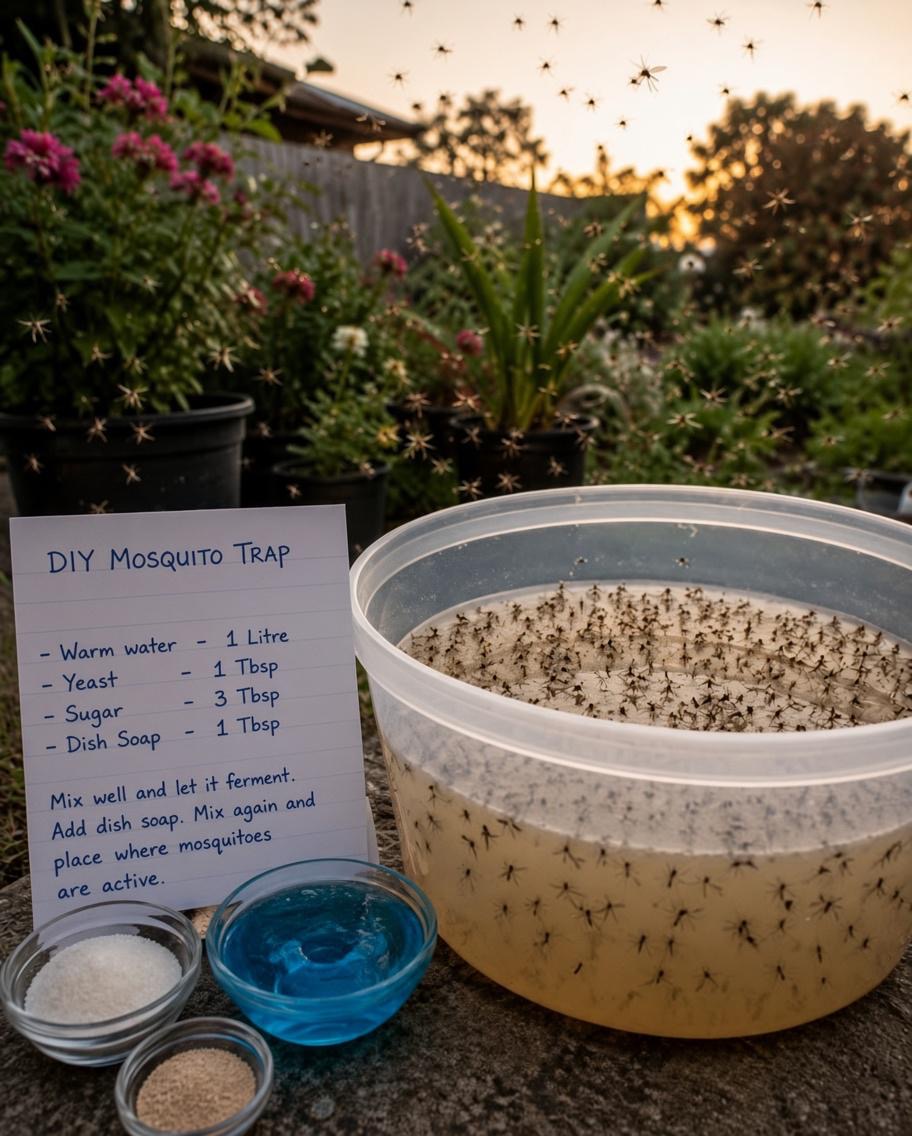
The Ultimate DIY Mosquito Trap
Introduction
Welcome back to the blog! Today, we’re taking a short break from our usual recipes to share a simple homemade solution for your backyard and patio.
If you enjoy outdoor dinners, gardening, or relaxing on the porch but dislike mosquitoes buzzing around, this DIY Mosquito Trap is an inexpensive project worth trying.
The idea is simple: yeast consumes sugar and produces carbon dioxide during fermentation. Because mosquitoes use carbon dioxide as one of the cues that help them locate people and animals, the mixture may act as a lure. A small amount of dish soap can also reduce the surface tension of the liquid.
This homemade mosquito trap uses inexpensive household ingredients and takes only a few minutes to prepare. For best results, use it as an extra mosquito-control measure, alongside removing standing water, using screens, and following local mosquito-control recommendations.
Recipe Overview
| Information | Details |
| Preparation Time | 5 minutes |
| Fermentation Time | 15–30 minutes |
| Total Time | About 35 minutes |
| Yield | 1 large DIY trap |
| Category | DIY Home & Garden |
| Type | Outdoor mosquito lure |
| Difficulty | Easy |
Why You’ll Love This DIY Mosquito Trap
Simple and inexpensive: You only need warm water, sugar, yeast, and a small amount of dish soap.
Quick to prepare: The mixture takes just a few minutes to assemble, making it an easy weekend DIY project.
Uses common household ingredients: There is no need for specialized equipment or expensive mosquito traps.
Useful as part of a larger mosquito-control routine: While a homemade yeast trap may attract some mosquitoes, the most reliable approach is to combine several prevention methods.
Ingredients
| Ingredient | Quantity | Notes |
| Warm Water | 1 liter (4¼ cups) | Warm, not hot |
| Granulated Sugar | 3 tablespoons (about 38 g) | Regular white sugar works well |
| Active Dry or Instant Yeast | 1 tablespoon (about 9 g) | Fresh yeast gives the best fermentation |
| Dish Soap | 1 tablespoon (15 mL) | Use a regular household dishwashing liquid |
Equipment
- 1 large bucket, container, or deep bowl
- Measuring spoons
- Wooden spoon or stirrer
- Optional: a funnel for easier pouring
- Optional: a loose cover or mesh to help keep larger debris out
Step-by-Step Instructions
1. Prepare the Water
Pour 1 liter (4¼ cups) of warm water into a clean bucket or large container.
The water should feel comfortably warm rather than hot. Very hot water can damage the yeast and interfere with fermentation.
2. Add the Sugar
Add 3 tablespoons of granulated sugar to the warm water.
Stir thoroughly until most of the sugar has dissolved.
3. Add the Yeast
Sprinkle 1 tablespoon of yeast over the sugar water.
Stir gently to distribute the yeast throughout the mixture.
Allow the mixture to sit for approximately 10–15 minutes.
You may notice a light foam or bubbling as fermentation begins.
4. Add the Dish Soap
Add 1 tablespoon of dish soap to the mixture.
Stir very gently for a few seconds.
Avoid creating excessive foam because you want the mixture to continue releasing carbon dioxide naturally.
5. Place the Trap Outdoors
Place the container in an outdoor area where mosquitoes are commonly noticed, such as near a patio or seating area.
For safety and convenience, place it somewhere stable and away from children and pets.
Do not place it directly beside people while they are sitting outside. The goal is to use it as one part of your overall mosquito-management strategy rather than relying on it as a barrier.
6. Check the Trap
Check the mixture periodically.
The yeast will gradually consume the sugar and produce carbon dioxide. Fermentation will eventually slow down, so the mixture will need to be replaced when it is no longer actively fermenting.
For the best hygiene, empty and clean the container regularly rather than allowing old liquid to sit outdoors indefinitely.
Best Tips for Better Results
Use Warm Water, Not Hot Water
The water should be warm enough to support fermentation but not hot enough to damage the yeast.
If the water is extremely hot, allow it to cool before adding the yeast.
Keep the Mixture Fresh
Freshly prepared yeast mixtures ferment more actively than old mixtures. Replace the solution regularly instead of expecting one batch to work indefinitely.
Choose the Location Carefully
Place the trap in a shaded outdoor location where mosquitoes are present, but keep it away from children’s play areas, pets, food-preparation areas, and places where people sit for long periods.
Eliminate Standing Water
This is one of the most important steps in mosquito prevention.
Regularly empty water from flowerpot saucers, buckets, toys, clogged gutters, birdbaths, and other containers where mosquitoes can breed.
A DIY trap cannot compensate for a yard containing numerous mosquito-breeding sites.
Best Ingredient Options
Sugar
Regular granulated white sugar is inexpensive and works well for fermentation.
There is generally no need to spend extra money on specialty sugars.
Yeast
Active dry yeast or instant yeast can both be used.
Make sure the yeast is fresh enough to ferment properly.
Dish Soap
A small amount of ordinary dishwashing liquid is sufficient. Avoid adding large quantities because excessive soap can create unnecessary foam.
DIY Mosquito Trap Variations
Smaller Trap
For a smaller container, reduce all ingredients proportionally.
For example, use approximately 500 mL (2 cups) of warm water, 1½ tablespoons sugar, 1½ teaspoons yeast, and ½ tablespoon dish soap.
Outdoor Bucket Version
For larger outdoor spaces, you can prepare the mixture in a larger bucket while keeping the ingredient proportions consistent.
However, making a larger quantity does not guarantee that the trap will catch more mosquitoes.
Covered Container Version
If you’re concerned about leaves, insects, or outdoor debris getting into the mixture, you can use a container with a suitable loose cover or mesh arrangement that still allows airflow.
Do not completely seal a fermenting container because fermentation produces gas.
What to Do Alongside the Trap
For more effective mosquito control, combine the trap with several prevention measures.
Remove standing water: Empty containers at least weekly and address places where water collects.
Use screens: Make sure window and door screens are intact.
Wear appropriate clothing: When mosquitoes are active, long sleeves and long pants can reduce exposed skin.
Use an appropriate mosquito repellent: Follow the product label when using an EPA-registered or locally approved insect repellent.
Maintain your outdoor space: Keep vegetation managed and eliminate unnecessary containers that can collect rainwater.
Make-Ahead Instructions
This mixture is best prepared fresh rather than stored for a long period.
You can measure the dry ingredients in advance, but combine them with warm water when you’re ready to use the trap.
Do not store a fermenting mixture in a tightly sealed bottle or container.
Storage
The prepared mixture is not intended for long-term storage.
If you are no longer using the trap, dispose of the liquid appropriately, rinse the container thoroughly, and prepare a fresh batch when needed.
Common Mistakes to Avoid
Using Boiling Water
Extremely hot water can damage or kill the yeast, preventing effective fermentation.
Adding Too Much Dish Soap
More soap does not necessarily make the trap better. Excessive soap can produce a large amount of foam and interfere with the mixture.
Leaving Standing Water Nearby
This defeats much of the purpose of mosquito prevention because stagnant water can provide breeding habitat.
Placing the Trap Right Beside People
A homemade lure should not be treated as a mosquito shield. Keep it away from areas where people are gathered and focus on reducing mosquito breeding sites and bites.
Expecting Thousands of Mosquitoes to Be Caught
Results can vary significantly depending on mosquito species, weather, temperature, location, and other environmental conditions.
This DIY trap may attract some mosquitoes, but it should not be advertised as a guaranteed way to eliminate mosquitoes.
Frequently Asked Questions
Does a yeast and sugar mosquito trap really work?
Yeast fermentation produces carbon dioxide, which is one of the cues mosquitoes use when locating hosts. However, the effectiveness of homemade traps can vary considerably, and they should not be considered a complete mosquito-control solution.
How long does the mixture last?
Fermentation gradually slows as the available sugar is consumed. For practical household use, prepare a fresh mixture when the bubbling and fermentation have noticeably decreased.
Can I use instant yeast?
Yes. Instant yeast can be used for this type of fermentation mixture.
Can I use brown sugar?
Yes, although ordinary white granulated sugar is inexpensive and convenient.
Can I leave the trap outside overnight?
You can leave the container outdoors if it is positioned safely and securely. Keep it away from children, pets, food, and areas where people are sitting.
Will this trap eliminate mosquitoes from my yard?
No. A homemade trap should not be expected to eliminate mosquitoes from an entire yard.
The most effective mosquito-management strategy combines several approaches, particularly eliminating standing water and preventing mosquitoes from reaching people.
What is the most important thing I can do to reduce mosquitoes?
Look for and eliminate standing water around your property. Mosquitoes can breed in surprisingly small amounts of stagnant water, so regularly checking outdoor containers and drainage areas is important.
Final Thoughts
This Ultimate DIY Mosquito Trap is a simple, inexpensive outdoor project made with ingredients you may already have at home.
The sugar and yeast create a fermenting mixture that releases carbon dioxide, while the dish soap changes the surface properties of the liquid.
Just remember that a homemade trap is best viewed as an additional mosquito-control measure, not a guaranteed solution. For a more effective backyard strategy, combine it with standing-water removal, window and door screens, appropriate repellents, and other proven mosquito-control practices.
With a few basic ingredients and a little preparation, you can experiment with this easy DIY project and see how it performs in your own outdoor space.
⚠️ This DIY mosquito trap may not be suitable for everyone. Keep the mixture away from children, pets, food, and drinking water, and use household products only according to their labels.
e