
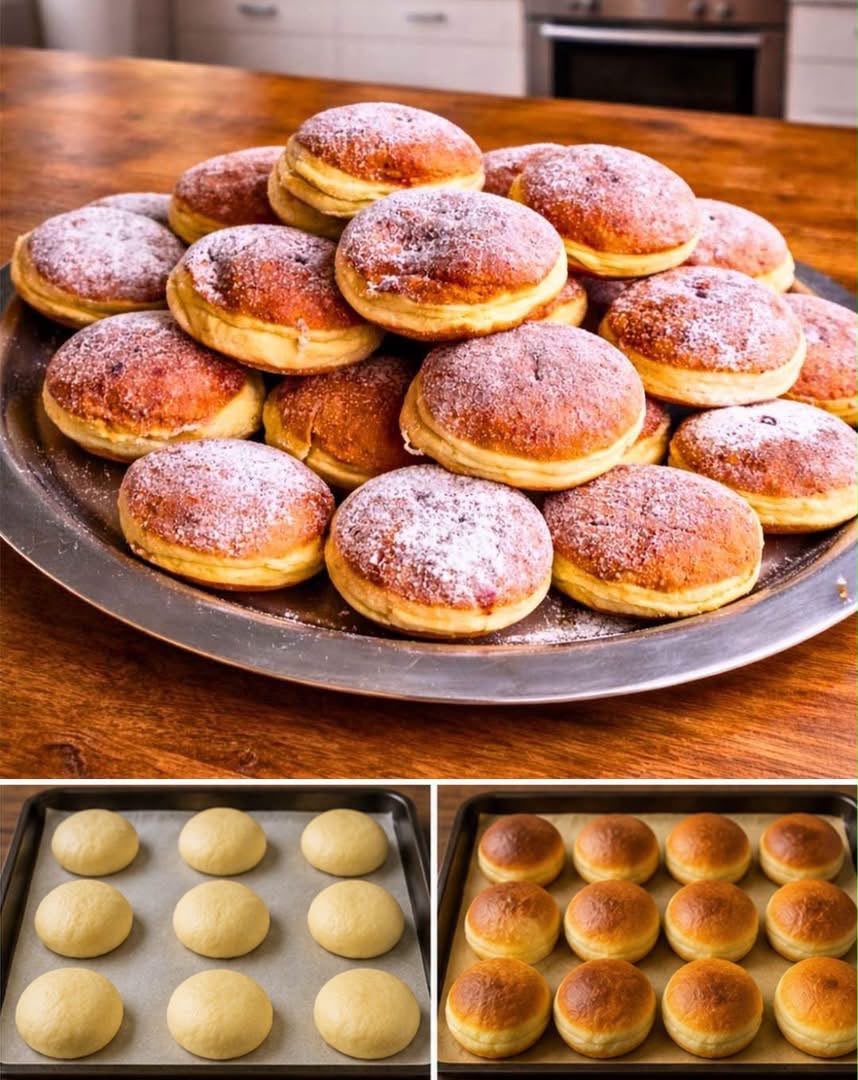
These Soft Oven-Baked Filled Donuts are a delicious lighter alternative to traditional deep-fried donuts. They are made with a soft, enriched yeast dough, baked until lightly golden, then filled with your favorite jam, fruit compote, or chocolate spread.
The dough is enriched with eggs, milk, sugar, and butter, giving these homemade donuts a tender, fluffy texture. A generous dusting of powdered sugar adds the perfect finishing touch.
They are wonderful for breakfast, afternoon snacks, brunch, or homemade desserts.
Recipe Overview
| Category | Details |
| Recipe | Oven-Baked Filled Donuts |
| Prep Time | 30 minutes |
| First Rise | 1½–2 hours |
| Second Rise | 45–60 minutes |
| Bake Time | 12–15 minutes |
| Total Time | About 3½–4 hours |
| Yield | About 16–18 donuts |
| Serving Size | 1 donut |
| Oven Temperature | 180°C / 350°F |
| Difficulty | Easy to Intermediate |
Why You’ll Love This Recipe
These homemade baked donuts are soft, fluffy, and incredibly satisfying without requiring a deep fryer.
The enriched yeast dough gives them a delicate texture, while the filling adds a sweet surprise inside every bite.
They are also easy to customize. You can fill them with strawberry jam, apricot preserves, apple compote, chocolate-hazelnut spread, or another favorite filling.
Because they are baked rather than deep-fried, they are also much less messy to prepare in your kitchen.
Ingredients
For the Donut Dough
| Ingredient | Amount |
| All-purpose flour, preferably T45 | 500 g |
| Fresh baker’s yeast | 20 g |
| OR active dry yeast | 7 g |
| Lukewarm milk | 200 ml |
| Granulated sugar | 60 g |
| Large eggs | 2 |
| Soft unsalted butter | 80 g |
| Fine salt | 1 pinch |
For the Filling and Decoration
| Ingredient | Amount |
| Jam, fruit compote, or chocolate spread | As needed |
| Powdered sugar | For dusting |
Strawberry, raspberry, apricot, or mixed-fruit jam all work beautifully in this recipe.
Step-by-Step Instructions
1. Activate the Yeast
Pour the lukewarm milk into a small bowl.
Add the fresh yeast or dry yeast along with 1 teaspoon of the sugar.
Stir gently and let the mixture stand for approximately 10 minutes.
If using active dry yeast, you should see some light foaming or bubbling, which indicates that the yeast is becoming active.
The milk should be warm but not hot. Excessively hot milk can damage the yeast.
2. Prepare the Dough
Place the flour, remaining sugar, and salt in the bowl of a stand mixer or a large mixing bowl.
Make a well in the center.
Add the eggs and the milk-yeast mixture.
Begin mixing until a rough dough starts to form.
If using a stand mixer, use the dough hook attachment.
3. Add the Butter
Cut the softened butter into small pieces.
Add it gradually to the dough while continuing to knead.
Knead for approximately 10 minutes, or until the dough becomes smooth, elastic, and pulls away from the sides of the bowl.
The dough should be soft and slightly tacky, but it should have enough structure to be handled.
Avoid adding excessive flour because this can make the finished donuts dense instead of light and fluffy.
4. First Rise
Shape the dough into a ball.
Place it in a lightly greased bowl and cover it with a clean kitchen towel or plastic wrap.
Leave it in a warm, draft-free place for approximately 1½ to 2 hours, or until the dough has roughly doubled in volume.
The exact rising time depends on the temperature of your kitchen.
5. Shape the Donuts
Once the dough has doubled in size, gently press it down to release some of the excess gas.
Transfer it to a lightly floured work surface.
Divide the dough into equal portions of approximately 50–60 g each.
Roll each portion between your hands to form a smooth, round ball.
Try to create a smooth surface on each dough ball because this will help the donuts bake evenly.
6. Arrange on the Baking Sheet
Line a baking sheet with parchment paper.
Place the dough balls on the prepared sheet, leaving enough space between them so they can expand during the second rise.
Cover the tray loosely with a clean kitchen towel.
7. Second Rise
Allow the shaped donuts to rise for another 45–60 minutes.
They should become noticeably puffier and lighter.
Do not let them rise excessively, as over-proofed dough can lose its structure during baking.
8. Bake the Donuts
Preheat your oven to 180°C / 350°F.
Place the tray in the preheated oven.
Bake for approximately 12–15 minutes, or until the donuts are lightly golden brown on top.
Because oven temperatures vary, begin checking them around the 12-minute mark.
You want the donuts to be cooked through while remaining soft and tender.
9. Cool the Donuts
Remove the tray from the oven.
Allow the donuts to cool for several minutes before transferring them to a wire rack.
Let them cool enough to handle comfortably before filling.
10. Fill the Donuts
Transfer your chosen jam, compote, or chocolate spread into a piping bag fitted with a narrow nozzle.
Make a small opening in the side of each donut using the tip of the piping nozzle or a small skewer.
Insert the nozzle into the center of the donut and gently squeeze to fill.
Do not overfill, as too much filling can cause the donut to split.
11. Add the Finishing Touch
Arrange the filled donuts on a large serving platter.
Generously dust the tops with powdered sugar.
Serve once the filling and donuts have reached a pleasant serving temperature.
Best Tips for Soft, Fluffy Donuts
Make sure the milk is lukewarm rather than hot. This gives the yeast a comfortable environment to activate.
Use properly softened butter. Very cold butter can be difficult to incorporate evenly into the dough.
Give the dough enough time to rise. The dough should visibly increase in volume during both fermentation stages.
Avoid adding too much flour. A stiff dough usually produces heavier baked donuts.
Try to make the dough balls similar in size so they bake at the same rate.
Keep the shaped dough covered during the second rise to prevent the surface from drying out.
Do not overbake the donuts. They only need to become lightly golden. Baking them for too long can make them dry.
Fill the donuts only after they have cooled enough to handle safely.
Best Filling Options
Strawberry jam provides a classic fruity filling and pairs beautifully with the soft dough.
Apricot or raspberry preserves give the donuts a slightly tangy flavor that balances the sweetness.
Apple compote creates a cozy, homemade filling that works especially well during autumn.
Chocolate-hazelnut spread is an excellent option for chocolate lovers.
You can also use pastry cream, vanilla cream, or lemon curd if you want a richer dessert-style filling.
Recipe Variations
Cinnamon Sugar Donuts
Instead of powdered sugar, lightly brush the warm donuts with melted butter and coat them in a mixture of cinnamon and sugar.
Chocolate-Filled Donuts
Fill the cooled donuts with chocolate-hazelnut spread or a thick chocolate pastry cream.
Raspberry Donuts
Use seedless raspberry jam for a bright, fruity filling with a beautiful color.
Lemon Cream Donuts
Fill the donuts with homemade or prepared lemon curd for a fresh citrus flavor.
Vanilla Cream Donuts
A smooth vanilla pastry cream transforms these simple baked donuts into an elegant dessert.
Mini Baked Donuts
Divide the dough into smaller portions of approximately 30–40 g each and reduce the baking time slightly. Watch them carefully because smaller donuts bake faster.
What to Serve With Baked Donuts
These donuts are delicious with coffee, espresso, tea, or hot chocolate.
For breakfast or brunch, serve them alongside fresh fruit and yogurt.
For a dessert platter, arrange them with different fillings so guests can choose their favorite flavor.
They are especially delicious when served slightly warm or at room temperature with a generous dusting of powdered sugar.
Make-Ahead Instructions
The dough can be prepared in advance and refrigerated after mixing.
Cover the dough tightly and refrigerate it overnight. The cold environment slows the yeast activity and allows you to continue shaping and baking the donuts the next day.
Before shaping, allow the dough to sit at room temperature long enough to become easier to handle.
You can also bake the donuts earlier in the day and fill them shortly before serving.
Storage
Store filled donuts in an airtight container at room temperature for approximately 1–2 days if using a shelf-stable jam filling.
If using a dairy-based cream filling, refrigerate the donuts and consume them within the recommended safe storage period for that filling.
For the softest texture, allow refrigerated donuts to sit at room temperature briefly before serving when appropriate.
Reheating
To gently refresh an unfilled or jam-filled donut, warm it in a microwave for approximately 8–12 seconds.
You can also place the donuts in a low oven for a few minutes.
Avoid overheating them because excessive heat can dry out the dough and make the filling extremely hot.
Freezing
The baked donuts can be frozen before filling.
Allow them to cool completely, then place them in a freezer-safe container or bag with parchment paper between layers if needed.
Freeze for up to approximately 2–3 months for the best quality.
Thaw at room temperature, then fill with jam, compote, or chocolate spread and dust with powdered sugar.
Common Mistakes to Avoid
Do not use very hot milk when activating the yeast because excessive heat can prevent proper fermentation.
Do not rush the first or second rise. Proper proofing is essential for light, fluffy donuts.
Avoid adding too much flour during kneading or shaping. The dough should remain soft and elastic.
Do not make the dough balls dramatically different in size, because smaller pieces will finish baking before larger ones.
Avoid overbaking. The donuts should be lightly golden rather than dark brown.
Do not add the filling while the donuts are extremely hot. Allow them to cool enough that the filling maintains its texture and the piping process is easy.
Nutrition Estimate
The following values are approximate and will vary depending on the filling and amount of powdered sugar used.
| Nutrient | Approximate Amount Per Donut |
| Calories | 220 kcal |
| Carbohydrates | 32 g |
| Protein | 5 g |
| Fat | 8 g |
| Saturated Fat | 4 g |
| Sugar | 12 g |
| Fiber | 1 g |
| Sodium | 140 mg |
Frequently Asked Questions
Can I use dry yeast instead of fresh yeast?
Yes. Use approximately 7 g of dry baker’s yeast in place of 20 g of fresh yeast.
Why aren’t my donuts fluffy?
The most common reasons are insufficient proofing, inactive yeast, adding too much flour, or overbaking. Make sure the dough has visibly expanded during both rising stages.
Can I use whole wheat flour?
You can replace part of the all-purpose flour with whole wheat flour, but using too much may produce a denser texture. For especially soft donuts, keep most of the flour as white all-purpose flour.
Can I fill the donuts before baking?
For this particular recipe, it is easier and more reliable to bake the dough balls first and fill them afterward.
What is the best filling for baked donuts?
Jam, fruit compote, chocolate spread, pastry cream, and lemon curd are all excellent choices. The best option depends on your preferred flavor.
Can I make the dough without a stand mixer?
Yes. You can knead the dough by hand in a large bowl. Because the dough contains butter and eggs, it may require approximately 12–15 minutes of kneading to become smooth and elastic.
How do I prevent the filling from leaking?
Use a piping bag with a narrow nozzle and add the filling gradually. Stop when the donut feels nicely filled but before the sides begin to split.
Can I make these donuts without filling?
Yes. They are delicious plain, dusted with powdered sugar, or coated with cinnamon sugar.
Final Thoughts
These Soft Oven-Baked Filled Donuts are a wonderful homemade treat when you want the texture of a fluffy yeast donut without deep-frying.
The enriched dough creates a soft and tender center, while your favorite jam, compote, or chocolate filling adds sweetness inside. A simple dusting of powdered sugar gives them the perfect finishing touch.
They are easy enough for a weekend baking project and versatile enough to customize with different fillings and toppings.