
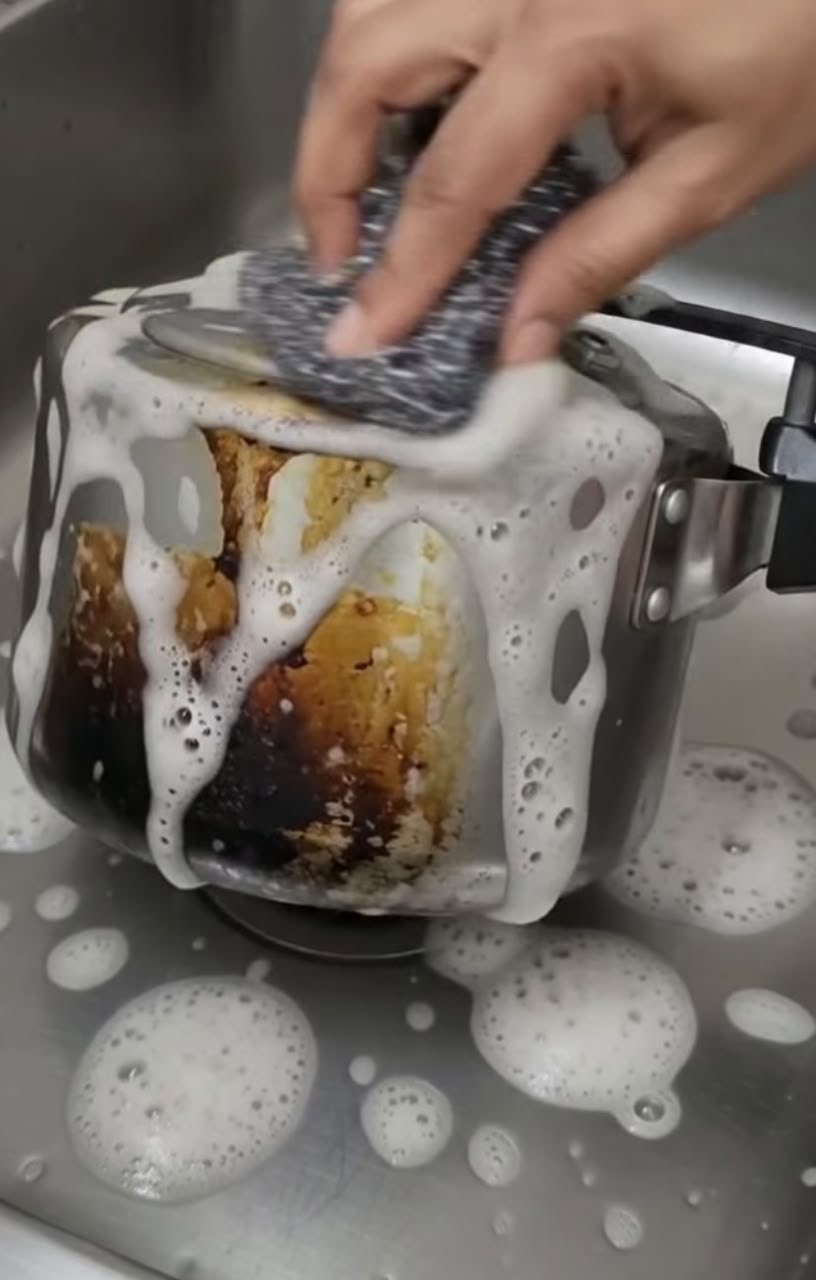
Burnt-on food, baked-on grease, and dark stains on the outside of pots and pressure cookers can be difficult to remove with ordinary dish soap.
This simple homemade cleaning mixture combines baking soda, coarse salt, dish soap, and white vinegar to help loosen stubborn grime before scrubbing.
Ingredients
| Ingredient | Amount |
| Baking soda | 2 tablespoons |
| Coarse salt | 1 tablespoon |
| Dish soap | 2 tablespoons |
| White vinegar | ½ cup |
| Metal scrubber or steel wool | 1 |
Step-by-Step Instructions
1. Prepare the Burnt Surface
Turn the pot upside down over a sink or another suitable cleaning area.
Make sure the surface is cool before starting.
2. Add the Baking Soda and Salt
Sprinkle 2 tablespoons of baking soda evenly over the burnt or greasy area.
Add 1 tablespoon of coarse salt over the baking soda.
The slightly abrasive texture can help loosen stubborn residue during scrubbing.
3. Add the Dish Soap
Pour approximately 2 tablespoons of dish soap over the powdered ingredients.
Spread it across the stained area as evenly as possible.
4. Add the White Vinegar
Slowly pour ½ cup of white vinegar over the mixture.
The vinegar will react with the baking soda, creating a temporary fizzing and foaming reaction.
This reaction can help spread the mixture across the surface, although the bubbling itself is not what removes all of the burnt grease.
5. Let It Sit
Allow the mixture to sit for approximately 10–15 minutes.
For particularly stubborn residue, you can place paper towels lightly soaked with vinegar over the area to help keep the mixture moist.
Do not allow the mixture to dry completely.
6. Scrub the Surface
Using an appropriate scrubber, work in small circular motions over the stained area.
Apply moderate pressure and continue until the loosened residue begins to come away.
7. Rinse Thoroughly
Rinse the surface thoroughly with warm water to remove the cleaning mixture and loosened grease.
If necessary, repeat the process rather than applying excessive force.
Dry the cookware with a clean towel.
Important Safety Tips
Check the cookware material before using a metal scrubber. Steel wool or metal scouring pads can scratch stainless steel, aluminum, enamel, ceramic coatings, and especially non-stick surfaces.
For non-stick or delicate cookware, use a soft sponge or a non-abrasive scrubber instead.
Do not use this method on a hot pot or immediately after cooking. Allow the cookware to cool completely first.
If cleaning a pressure cooker, never immerse or aggressively scrub components such as the pressure valve, sealing ring, or other safety mechanisms. Clean those parts according to the manufacturer’s instructions.
Will Baking Soda and Vinegar Remove Burnt Grease?
The combination can help loosen and clean certain types of residue, especially when combined with dish soap and gentle mechanical scrubbing.
However, baking soda and vinegar largely neutralize each other when mixed together. The impressive fizz does not mean the mixture has become a powerful grease-dissolving cleaner.
For heavy grease, dish soap and physical scrubbing are often more important than the bubbling reaction.
For Extremely Stubborn Burnt Marks
If one application does not remove the stains, avoid immediately using stronger chemicals or excessive force.
Instead, repeat the cleaning process or use a cleaning method specifically recommended for your cookware’s material.
Always check the manufacturer’s care instructions before using abrasive products.
Final Thoughts
This homemade cleaning mixture can be useful for loosening stubborn grease and burnt residue from suitable cookware surfaces.
The combination of baking soda, coarse salt, dish soap, and white vinegar provides a simple cleaning option, but the scrubbing method and the type of cookware are important factors.
For delicate, coated, enamel, or non-stick surfaces, replace the metal scrubber with a non-abrasive sponge to avoid permanent scratches or damage.