
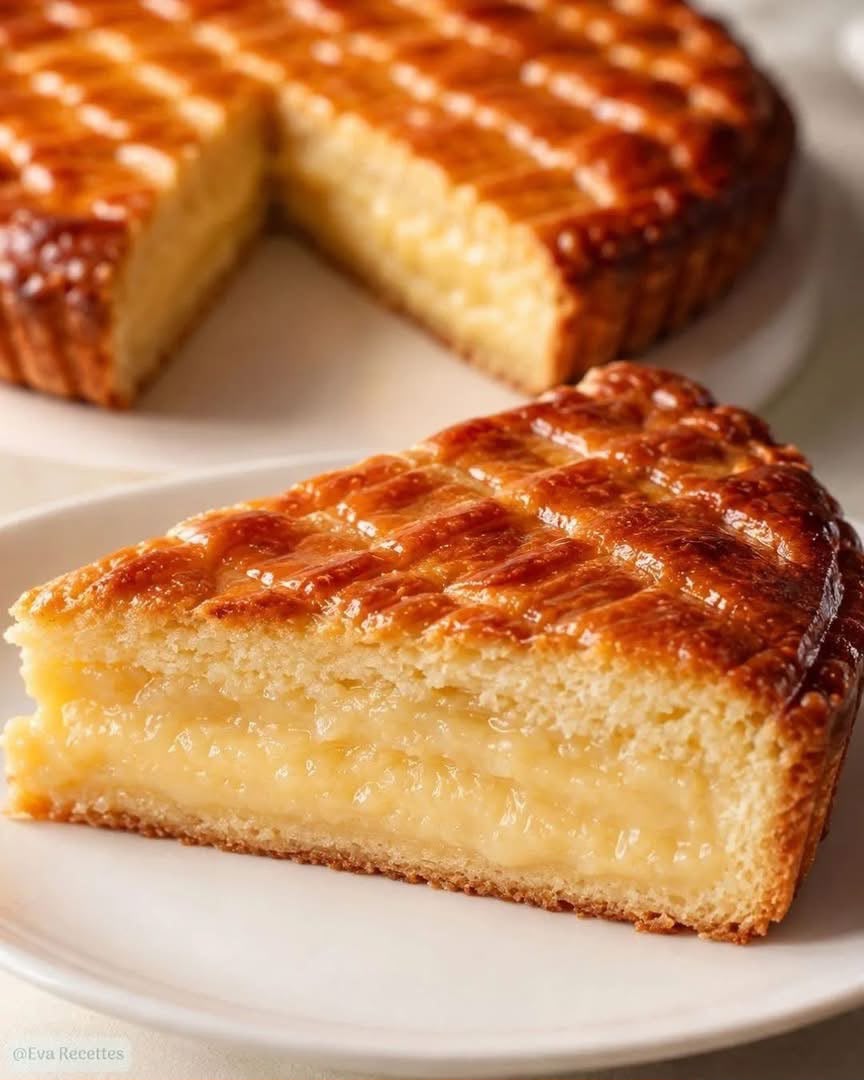
Classic Gâteau Basque with Vanilla Pastry Cream 🍰🇫🇷
Introduction
Gâteau Basque is one of the most beloved traditional desserts from the Basque region of France. It features a rich, buttery pastry crust surrounding a smooth and creamy vanilla pastry cream.
The signature golden top is traditionally decorated with a simple crosshatch pattern, giving this elegant cake its unmistakable appearance.
Although it looks impressive, the recipe is surprisingly approachable. The key is keeping the pastry dough chilled and allowing the finished cake to cool completely before slicing.
Recipe Overview
| Details | Information |
| Prep Time | 35 minutes |
| Chilling Time | 2 hours |
| Bake Time | 40–45 minutes |
| Cooling Time | 2 hours |
| Total Time | About 4 hours 20 minutes |
| Yield | 8–10 servings |
| Pan Size | 20 cm / 8-inch round |
| Difficulty | Intermediate |
| Cuisine | Basque / French |
Why You’ll Love This Recipe
This Gâteau Basque combines two irresistible textures: a tender, buttery crust and a silky vanilla pastry cream center.
The pastry has a delicate sweetness and rich buttery flavor that pairs beautifully with the creamy filling.
The finished cake also looks elegant enough for a dinner party, afternoon tea, holiday table, or special family gathering.
Best of all, it can be prepared ahead of time, and its flavor often becomes even better after resting overnight.
Ingredients
For the Vanilla Pastry Cream
| Ingredient | Amount |
| 🥛 Whole milk | 250 ml |
| 🥚 Large egg yolks | 3 |
| 🍚 Granulated sugar | 50 g |
| 🌽 Cornstarch | 25 g |
| 🌼 Vanilla extract | 1 tsp |
| 🧈 Unsalted butter | 15 g |
| 🧂 Salt | Small pinch |
For the Basque Pastry Dough
| Ingredient | Amount |
| 🧈 Unsalted butter, softened | 200 g |
| 🍚 Granulated sugar | 200 g |
| 🥚 Large eggs | 2 |
| 🌾 All-purpose flour | 300 g |
| 🥄 Baking powder | 1 tsp |
| 🧂 Salt | ¼ tsp |
For the Egg Wash
| Ingredient | Amount |
| 🥚 Large egg | 1 |
| 💧 Water or milk | 1 tsp |
Step-by-Step Instructions
Make the Vanilla Pastry Cream
Pour the whole milk into a medium saucepan.
Add the vanilla extract and warm the milk over medium heat until it is steaming and just beginning to simmer. Do not allow it to boil vigorously.
In a separate bowl, whisk together the egg yolks, sugar, cornstarch, and salt until smooth and slightly pale.
Slowly pour the hot milk into the egg mixture while whisking continuously. This gradually warms the eggs and helps prevent them from scrambling.
Pour the mixture back into the saucepan.
Cook over medium heat, whisking constantly, until the pastry cream becomes thick and smooth. Once it begins bubbling, continue cooking for about 30–60 seconds while whisking.
Remove the saucepan from the heat.
Stir in the butter until completely melted and incorporated.
Transfer the pastry cream to a clean bowl.
Press plastic wrap directly against the surface of the cream to prevent a skin from forming.
Refrigerate for at least 1 hour, or until completely cold.
Prepare the Basque Dough
Place the softened butter and sugar in a large mixing bowl.
Beat for approximately 2–3 minutes, until the mixture becomes creamy and light.
Add the eggs one at a time, mixing well after each addition.
In another bowl, whisk together the flour, baking powder, and salt.
Gradually add the dry ingredients to the butter mixture.
Mix just until a soft, thick dough forms. Avoid overmixing, as this can make the finished crust less tender.
Divide the dough into two portions, with one portion slightly larger if desired for the bottom and sides.
Wrap the portions tightly and refrigerate for at least 1 hour.
Assemble the Gâteau Basque
Preheat your oven to 180°C / 350°F.
Grease an 8-inch / 20-cm round springform pan. You can also line the bottom with parchment paper for easier removal.
Take the larger portion of chilled dough and place it between two sheets of parchment paper.
Roll it into a circle large enough to cover the bottom of the pan and come approximately 4–5 cm up the sides.
Carefully transfer the dough into the prepared pan.
Gently press it against the bottom and sides, making sure there are no large gaps or cracks.
Remove the chilled pastry cream from the refrigerator and whisk it briefly to make it smooth again.
Spread the pastry cream evenly over the dough.
Leave approximately 2–2.5 cm of space around the edge so the top crust can be sealed properly.
Add the Top Crust
Roll out the remaining dough between sheets of parchment paper until it forms a circle approximately 20 cm in diameter.
Carefully place the dough over the pastry cream.
Press the edges gently to connect the top crust with the bottom crust.
Seal the edges thoroughly so the pastry cream cannot escape during baking.
Trim away any excess dough around the edges if necessary.
Create the Signature Pattern
Whisk the egg with 1 teaspoon of water or milk.
Brush a thin, even layer of egg wash over the entire surface.
Using the back of a fork or the tines of a fork, gently create diagonal lines across the surface.
Repeat in the opposite direction to create the traditional crosshatch pattern.
Be careful not to cut deeply into the dough.
Bake
Place the cake in the center of the preheated oven.
Bake for approximately 40–45 minutes, or until the top is deeply golden brown and glossy.
The exact baking time can vary slightly depending on your oven and pan.
If the top begins browning too quickly, loosely cover it with aluminum foil during the final portion of baking.
Remove the Gâteau Basque from the oven and place it on a cooling rack.
Allow it to cool completely before attempting to slice it.
For the best texture, refrigerate it for several hours or preferably let it rest overnight.
Best Tips
Keep the Dough Cold
Chilled dough is much easier to handle and helps the cake maintain its shape during baking.
If the dough becomes sticky while assembling, place it back in the refrigerator for 10–15 minutes.
Use Properly Softened Butter
The butter should be soft enough to beat easily but should not be melted.
Melted butter can change the structure of the dough and make it difficult to work with.
Don’t Overcook the Pastry Cream
Once the pastry cream becomes thick and begins bubbling, it only needs a short additional cooking time.
Constant whisking helps create a smooth, lump-free filling.
Seal the Edges Well
Take extra care when joining the top and bottom crusts.
A well-sealed edge helps keep the pastry cream contained during baking.
Cool Completely
Don’t cut the cake while it is hot.
The pastry cream needs time to firm up, and slicing too early can cause the filling to spread.
Let It Rest Overnight
For the best flavor and texture, prepare the Gâteau Basque a day ahead.
The crust becomes beautifully tender while the vanilla flavor develops.
Best Ingredient Options
Vanilla
Pure vanilla extract works beautifully, but vanilla bean or vanilla bean paste provides an especially aromatic pastry cream.
Butter
Use good-quality unsalted butter for the best flavor and control over the salt level.
Flour
Regular all-purpose flour is ideal. Avoid using bread flour, which can produce a tougher pastry.
Milk
Whole milk gives the pastry cream a rich, creamy texture. Lower-fat milk can work, but the filling will be slightly less luxurious.
Recipe Variations
Cherry Gâteau Basque 🍒
For the traditional fruit version, replace the vanilla pastry cream with a layer of thick black cherry or cherry preserves.
Chocolate Pastry Cream 🍫
Add approximately 60 g of finely chopped dark chocolate to the hot pastry cream after removing it from the heat. Stir until completely melted.
Orange & Vanilla
Add finely grated orange zest to the pastry cream for a bright citrus aroma.
Almond Gâteau Basque
Replace approximately 40 g of the flour with finely ground almonds for a subtle nutty flavor.
Rum Vanilla
Add 1 tablespoon of dark rum to the cooled pastry cream for a more traditional French pastry-shop flavor.
What to Serve With
Gâteau Basque is delicious on its own, but it pairs beautifully with a cup of coffee or tea.
For a more elaborate dessert, serve a slice with fresh berries and a small spoonful of lightly sweetened whipped cream.
A dusting of powdered sugar can also be added immediately before serving.
Make-Ahead Instructions
The pastry cream can be prepared up to 2 days ahead and stored covered in the refrigerator.
The dough can also be prepared a day ahead and kept tightly wrapped in the refrigerator.
You can assemble the cake several hours before baking and keep it refrigerated until you’re ready to put it in the oven.
For entertaining, baking the Gâteau Basque the day before is highly recommended.
Storage
Allow the cake to cool completely before storing.
Because it contains pastry cream, keep the finished Gâteau Basque refrigerated in an airtight container or tightly covered.
It is best enjoyed within 3–4 days.
Reheating
Gâteau Basque is generally delicious cold or at room temperature.
For a slightly softer pastry, remove it from the refrigerator and allow it to sit at room temperature for approximately 30–60 minutes before serving.
Avoid heating individual slices for too long, as excessive heat can cause the pastry cream to become loose.
Freezing
For the best texture, freezing is not ideal because the pastry cream may change slightly after thawing.
If necessary, freeze the fully baked and cooled cake tightly wrapped for up to 1 month.
Thaw it overnight in the refrigerator, then allow it to come to room temperature before serving.
Common Mistakes to Avoid
Using warm pastry cream: The filling should be completely chilled before assembly.
Overworking the dough: Mix only until the flour disappears.
Rolling the dough too thin: A substantial crust is part of the characteristic texture of Gâteau Basque.
Leaving gaps around the edges: Make sure the top and bottom pastry layers are firmly sealed.
Cutting the cake while hot: Allow sufficient cooling time so the filling can set properly.
Skipping the chilling stages: Refrigeration makes the dough easier to handle and improves the final texture.
Nutrition Estimate
Approximate values per serving, assuming 10 servings:
| Nutrient | Estimated Amount |
| Calories | ~430 kcal |
| Carbohydrates | ~52 g |
| Protein | ~7 g |
| Fat | ~22 g |
| Saturated Fat | ~13 g |
| Sugar | ~26 g |
| Fiber | ~1 g |
| Sodium | ~150 mg |
Nutrition values are estimates and can vary depending on the specific ingredients and serving size.
Frequently Asked Questions
Can I make Gâteau Basque the day before?
Yes. In fact, making it the day before is one of the best ways to enjoy it. The pastry becomes slightly softer and the flavors have more time to develop.
Can I use cherry preserves instead of pastry cream?
Absolutely. Cherry-filled Gâteau Basque is a classic variation and is especially popular in the Basque region.
Why did my pastry cream become lumpy?
The most common causes are insufficient whisking or cooking the mixture too quickly. Whisk continuously while the cream thickens, and strain it through a fine-mesh sieve if necessary.
Can I use a regular cake pan?
Yes. A springform pan makes removal easier, but a standard round cake pan can also work if it is properly greased and lined.
How do I get a beautiful crosshatch pattern?
Apply a thin layer of egg wash first, then gently score the surface with a fork. Don’t press deeply enough to cut through the crust.
Should Gâteau Basque be served cold?
It can be served chilled, at room temperature, or slightly cool. For the best balance of texture and flavor, let it sit at room temperature for about 30–60 minutes before serving.
Final Thoughts
This Classic Gâteau Basque with Vanilla Pastry Cream is a beautiful example of French-Basque baking: simple ingredients transformed into an elegant dessert with a crisp golden exterior and creamy vanilla center.
The most important secrets are chilling the dough, preparing a smooth pastry cream, sealing the cake carefully, and allowing it to cool completely.
For the most authentic experience, make it the day before and serve generous slices alongside coffee or tea. 🍰✨