
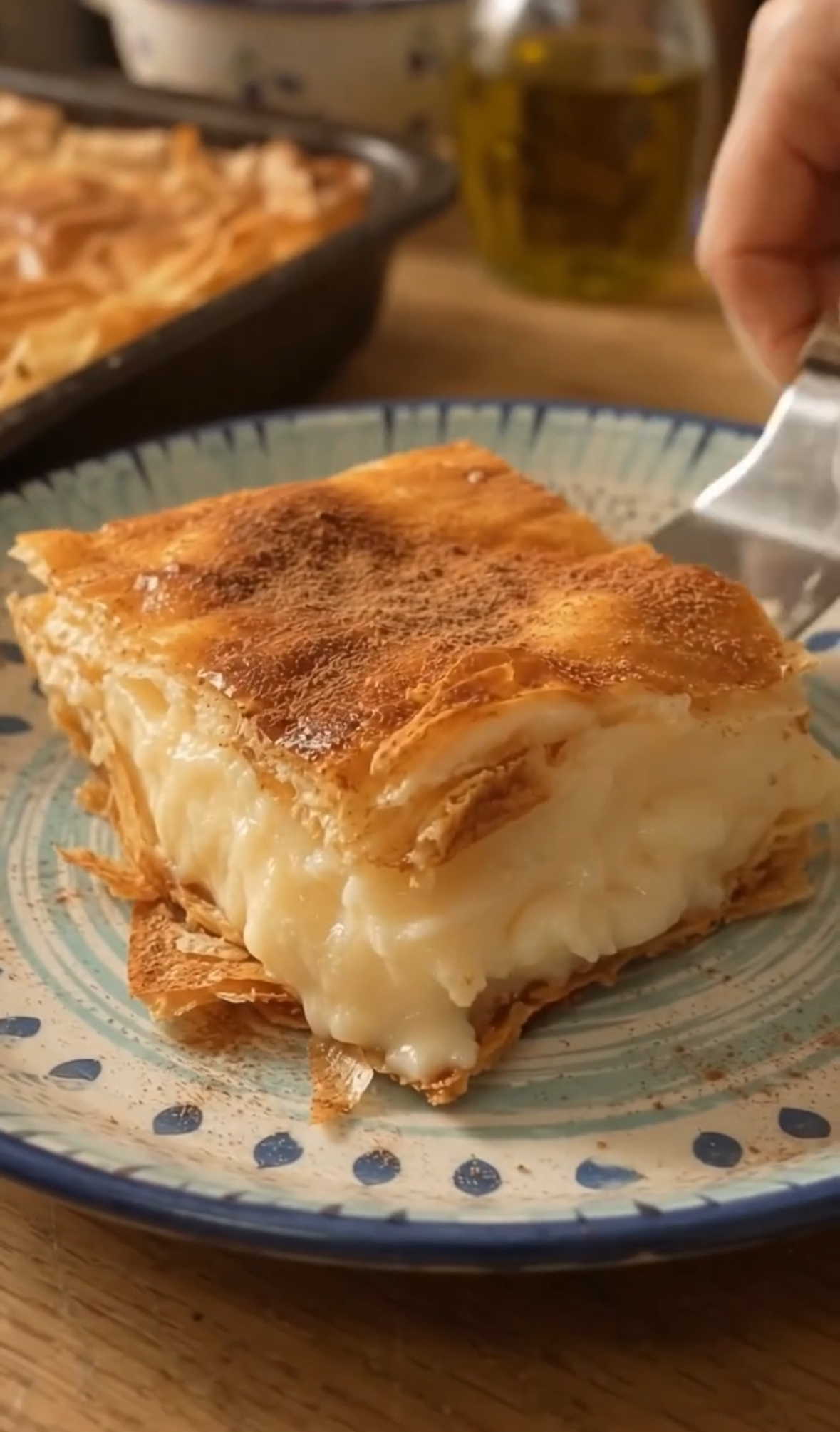
Galaktoboureko is a beloved Greek dessert made with a creamy, fragrant semolina custard baked between layers of crisp, golden phyllo pastry. Once it comes out of the oven, the hot pastry is generously soaked with a cool lemon-cinnamon syrup, creating a delicious contrast between crunchy phyllo and silky custard.
With its buttery layers, delicate citrus flavor, warm cinnamon notes, and sweet syrup, this traditional Greek dessert is perfect for holidays, family gatherings, or whenever you want an impressive homemade treat.
Recipe Overview
| Category | Details |
| Cuisine | Greek |
| Course | Dessert |
| Texture | Creamy, crisp, syrupy |
| Main Flavor | Lemon, vanilla & cinnamon |
| Servings | 12–16 |
| Prep Time | 30 minutes |
| Bake Time | 45–55 minutes |
| Rest Time | 1–2 hours |
Why You’ll Love This Recipe
This Galaktoboureko combines two textures that make every bite special: delicate, crispy phyllo pastry and a rich, smooth semolina custard.
The lemon-infused syrup adds brightness and sweetness without overpowering the creamy filling.
The cinnamon and vanilla give the dessert a warm, comforting aroma that makes it especially inviting when served for celebrations.
It can also be prepared ahead of time, making it a convenient dessert for dinner parties and special occasions.
Ingredients
For the Lemon-Cinnamon Syrup
| Ingredient | Amount |
| Granulated sugar | 2 cups |
| Water | 1 cup |
| Fresh lemon juice | 1 tablespoon |
| Lemon peel | 1 strip |
| Cinnamon stick | 1 |
| Honey | 2 tablespoons |
For the Semolina Custard
| Ingredient | Amount |
| Whole milk | 4 cups |
| Fine semolina | 1 cup |
| Granulated sugar | ¾ cup |
| Large eggs | 4 |
| Unsalted butter | ¼ cup |
| Vanilla extract | 1 teaspoon |
| Lemon zest | Zest of 1 lemon |
For the Phyllo Layers
| Ingredient | Amount |
| Phyllo pastry sheets | 1 package, 16 oz |
| Unsalted butter, melted | 1 cup |
| Ground cinnamon | For dusting |
Step-by-Step Instructions
1. Prepare the Syrup
Add the sugar, water, lemon peel, and cinnamon stick to a medium saucepan.
Bring the mixture to a boil over medium-high heat.
Reduce the heat and simmer for about 5–7 minutes, stirring occasionally, until the sugar has completely dissolved and the syrup has slightly thickened.
Remove the saucepan from the heat.
Stir in the honey and fresh lemon juice.
Remove the cinnamon stick and lemon peel if desired.
Allow the syrup to cool completely.
Important: The syrup should be completely cold when it is poured over the hot Galaktoboureko after baking. This helps the pastry absorb the syrup while maintaining its texture.
2. Prepare the Semolina Custard
Pour the whole milk into a medium saucepan.
Add half of the sugar, approximately ⅜ cup, along with the vanilla extract.
Heat over medium heat until the milk is hot and beginning to gently simmer.
Do not allow it to boil aggressively.
Slowly sprinkle the fine semolina into the warm milk while whisking continuously.
Continue cooking over low to medium-low heat, whisking constantly, for about 5–7 minutes.
The mixture should gradually thicken into a smooth, pudding-like consistency.
Remove the saucepan from the heat.
Whisk in the ¼ cup of butter and the lemon zest until the butter has completely melted.
3. Whisk the Eggs
In a separate large bowl, whisk the eggs together with the remaining sugar.
Continue whisking for approximately 2–3 minutes until the mixture becomes lighter in color and slightly fluffy.
Gradually incorporate the warm semolina mixture into the eggs, whisking gently and continuously.
This helps prevent the eggs from cooking too quickly.
Continue until the custard is smooth and evenly combined.
4. Prepare the Phyllo
Preheat your oven to 175°C / 350°F.
Brush a 9 × 13-inch baking dish generously with some of the melted butter.
Carefully unroll the thawed phyllo pastry.
Place one sheet into the baking dish.
Brush lightly with melted butter.
Add another sheet and brush again.
Continue layering until you have used approximately 8 sheets.
Allow some of the phyllo sheets to extend over the edges of the baking dish.
Keep unused phyllo covered with a clean, slightly damp kitchen towel while working so that it does not dry out.
5. Add the Custard
Pour the prepared semolina custard over the phyllo base.
Spread it gently with a spatula so that the surface is even.
Do not press down heavily on the custard.
Fold the overhanging phyllo edges inward over the custard.
Brush the folded pastry lightly with melted butter.
6. Add the Top Phyllo Layers
Place the remaining phyllo sheets over the custard one at a time.
Brush each sheet lightly with melted butter before adding the next one.
Tuck any loose edges carefully into the sides of the baking dish.
Brush the final layer generously but evenly with melted butter.
7. Score the Pastry
Using a sharp knife, lightly score the top layers of phyllo into squares or rectangles.
Do not cut all the way through the custard.
Scoring the pastry before baking makes it much easier to portion after the dessert has been soaked with syrup.
For an especially crisp top, lightly sprinkle a few drops of cold water over the surface.
8. Bake
Place the baking dish in the preheated oven.
Bake for approximately 45–55 minutes, or until the phyllo is deeply golden brown, crisp, and beautifully puffed.
Keep an eye on the pastry during the final 10 minutes. If it is browning too quickly, loosely cover the top with aluminum foil.
9. Add the Syrup
Remove the Galaktoboureko from the oven while it is still piping hot.
Slowly ladle the cold syrup over the entire surface.
Pour gradually, allowing the syrup to absorb into the layers before adding more.
You may hear the pastry crackle as the cold syrup meets the hot phyllo.
Allow the dessert to rest at room temperature for at least 1–2 hours.
This resting period gives the custard time to set and allows the syrup to distribute throughout the pastry.
10. Serve
Once the Galaktoboureko has rested, finish it with a light dusting of ground cinnamon.
Cut along the pre-scored lines and serve.
For the best texture, serve at room temperature or slightly chilled.
Best Tips for Perfect Galaktoboureko
Keep the phyllo covered while assembling the dessert. Phyllo dries out very quickly when exposed to air, making it difficult to handle without tearing.
Butter each sheet lightly and evenly. Too little butter can produce dry layers, while excessive butter can make the pastry greasy.
Use fine semolina for the smoothest custard texture.
Whisk the semolina continuously while it cooks to prevent lumps from forming.
When combining the eggs with the warm custard, work gradually. Adding the hot custard too quickly can scramble the eggs.
Make sure the syrup is completely cool before pouring it over the hot pastry.
Do not rush the resting period. The dessert needs time to absorb the syrup and for the custard to become firm enough to slice neatly.
Best Ingredient Options
Whole milk produces the richest and creamiest custard.
Fine semolina is preferable because it creates a smooth filling with a delicate grain.
Fresh lemon zest gives the custard a brighter citrus aroma than bottled lemon flavoring.
Unsalted butter allows you to control the overall flavor and saltiness of the dessert.
For the best flavor, use real vanilla extract and fresh lemon juice.
Recipe Variations
For a stronger citrus flavor, add a little extra finely grated lemon zest to the custard.
Orange zest can also be used alongside the lemon for a slightly different Mediterranean-style flavor.
A small amount of ground cinnamon can be added to the custard for extra warmth.
For a more aromatic syrup, a small piece of orange peel can be added with the lemon peel.
You can also cut the finished Galaktoboureko into smaller diamond-shaped portions for a more traditional presentation.
What to Serve With Galaktoboureko
Galaktoboureko is delicious on its own because the syrup, custard, and pastry already provide plenty of flavor.
A small cup of strong Greek coffee makes an excellent pairing.
Unsweetened tea or espresso can also balance the sweetness of the dessert.
For a more indulgent presentation, serve individual pieces with a small scoop of vanilla ice cream.
Fresh berries can provide a pleasant tart contrast to the sweet syrup.
Make-Ahead Instructions
Galaktoboureko can be prepared several hours before serving.
The syrup can be made a day ahead and stored covered in the refrigerator.
The complete dessert can also be baked earlier in the day and allowed to absorb the syrup before serving.
For the crispest phyllo texture, avoid covering the dessert tightly while it is still warm because trapped steam can soften the pastry.
Storage
Allow leftover Galaktoboureko to cool completely.
Cover the baking dish loosely and refrigerate for up to 3–4 days.
The pastry may become softer as it absorbs more syrup, but the custard will remain creamy and flavorful.
Reheating
For the best texture, individual portions can be gently warmed in a preheated oven at approximately 160°C / 325°F for several minutes.
Avoid microwaving for too long because it can soften the phyllo considerably.
Galaktoboureko can also be enjoyed cold or at room temperature.
Freezing
For best results, freezing the fully syrup-soaked dessert is not recommended because the phyllo can lose much of its crispness after thawing.
If you need to freeze portions, wrap them very well and store them for up to about 1 month.
Thaw in the refrigerator and gently reheat in the oven.
Common Mistakes to Avoid
Do not leave the phyllo uncovered while assembling. It can dry out quickly and become brittle.
Do not skip the butter between the phyllo layers. The butter helps create the characteristic crisp, flaky texture.
Do not pour hot syrup over the hot pastry. Using cold syrup over freshly baked pastry helps maintain a better contrast of textures.
Do not cut the dessert immediately after adding the syrup. Giving it at least 1–2 hours to rest allows the custard to set and the syrup to distribute properly.
Do not overcook the custard. Once it becomes thick and pudding-like, remove it from the heat.
Nutrition Estimate
Nutrition will vary depending on portion size and the exact ingredients used.
| Nutrient | Approximate Amount Per Serving |
| Calories | 400–480 kcal |
| Carbohydrates | 55–65 g |
| Protein | 7–9 g |
| Fat | 18–23 g |
| Saturated Fat | 10–13 g |
| Sugar | 30–40 g |
| Fiber | 1–2 g |
| Sodium | 150–250 mg |
Frequently Asked Questions
Can I make Galaktoboureko the day before?
Yes. Galaktoboureko can be prepared ahead and stored covered in the refrigerator. Allowing it to rest also gives the flavors time to develop.
Why does my phyllo become soggy?
Phyllo naturally softens as it absorbs syrup. To preserve as much crispness as possible, bake it until deeply golden, use properly cooled syrup, and avoid covering it tightly while warm.
Can I use frozen phyllo?
Yes. Frozen phyllo works very well. Thaw it according to the package instructions, preferably overnight in the refrigerator.
Should the syrup be hot or cold?
For this method, the syrup should be completely cool while the freshly baked Galaktoboureko is hot.
Can I use orange instead of lemon?
Yes. Orange zest or a small amount of orange peel can be added for a sweeter citrus aroma.
How do I prevent the custard from becoming lumpy?
Whisk the semolina continuously while adding it to the milk and while the mixture thickens. When adding the eggs, incorporate the warm custard gradually while whisking.
Why does my Galaktoboureko crack?
Some cracking is completely normal. Phyllo is delicate, and the hot pastry expands and contracts during baking and soaking.
Can I serve Galaktoboureko cold?
Yes. It can be served chilled, at room temperature, or slightly warmed. Many people enjoy it at room temperature because the custard is creamy while the pastry retains some texture.
Final Thoughts
Galaktoboureko is one of those desserts that looks impressive but becomes much easier once the process is broken into simple stages.
Prepare the syrup first, make a smooth semolina custard, carefully layer the buttered phyllo, and bake until deeply golden. The final step—pouring cold syrup over the hot pastry—is what brings everything together.
The result is a beautifully layered Greek dessert with crisp, buttery pastry, creamy lemon-vanilla custard, and a fragrant cinnamon syrup.