
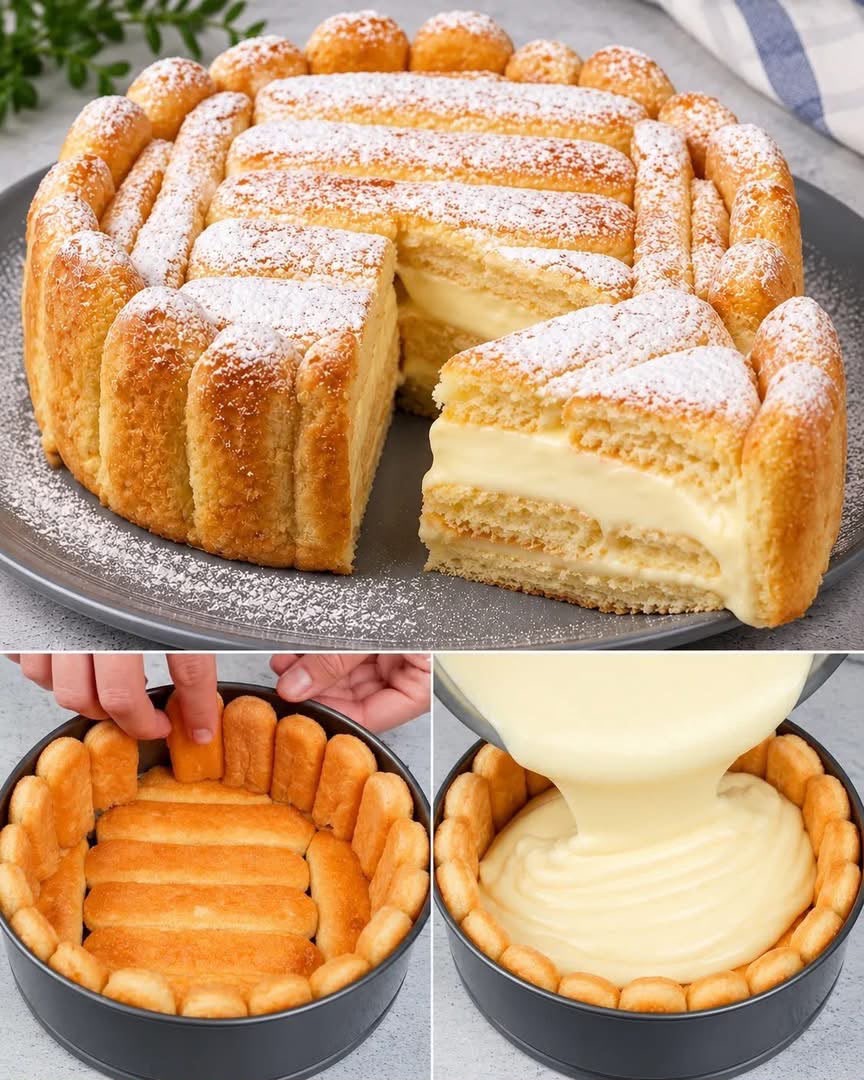
This No-Bake Vanilla Custard Charlotte Cake is an elegant and creamy dessert made with delicate ladyfinger biscuits and a silky homemade vanilla custard cream.
With its beautiful biscuit border and soft, luxurious vanilla filling, this classic-style Charlotte looks impressive while requiring no oven. The cake is assembled in a springform pan and chilled until the biscuits become tender and the custard sets into a sliceable, creamy dessert.
It is perfect for birthdays, afternoon tea, holidays, family gatherings, or whenever you want an elegant dessert without complicated baking.
Recipe Overview
| Category | Details |
| Preparation Time | 25 minutes |
| Chill Time | At least 4 hours |
| Total Time | About 4 hours 25 minutes |
| Servings | 8–10 |
| Pan | 8-inch (20 cm) springform pan |
| Difficulty | Easy to Moderate |
| Method | No-Bake |
Why You’ll Love This Recipe
This Charlotte cake looks sophisticated but is surprisingly simple to assemble.
The homemade vanilla custard gives the dessert a rich, creamy texture, while whipped cream makes the filling lighter and silkier.
The ladyfingers soften during refrigeration and become tender enough to cut easily with a fork.
Because the entire dessert can be prepared ahead of time, it is especially convenient for entertaining.
Ingredients
For the Ladyfinger Base and Structure
| Ingredient | Amount |
| Ladyfinger biscuits (Savoiardi) | 30–35 |
| Milk, optional for light dipping | ⅓ cup (80 ml) |
| Powdered sugar | For dusting |
The milk is optional. If your ladyfingers are already soft or delicate, you may not need to dip them.
For the Vanilla Custard Cream
| Ingredient | Amount |
| Large egg yolks | 4 |
| Granulated sugar | ½ cup (100 g) |
| Cornstarch | ⅓ cup (40 g) |
| Whole milk | 2 cups (500 ml) |
| Pure vanilla extract or vanilla bean paste | 1 teaspoon |
| Unsalted butter, softened | 2 tablespoons (30 g) |
| Heavy cream | ½ cup (120 ml) |
Whip the heavy cream to stiff peaks before using.
Step-by-Step Instructions
1. Make the Vanilla Custard
Begin by preparing the homemade vanilla custard.
In a medium saucepan, whisk the egg yolks and granulated sugar together until the mixture becomes lighter and slightly pale.
Add the cornstarch and whisk until completely smooth.
Gradually pour in the whole milk while whisking continuously. Adding the milk slowly helps prevent lumps from forming.
2. Cook the Custard
Place the saucepan over medium heat.
Cook the mixture while stirring constantly with a whisk or heat-resistant spatula.
As the mixture heats, it will gradually become thicker.
Continue cooking until the custard reaches a gentle boil and becomes thick enough to coat the back of a spoon.
Do not leave the saucepan unattended because the custard can stick or form lumps quickly.
3. Add the Vanilla and Butter
Remove the saucepan from the heat.
Immediately stir in the softened butter and vanilla extract or vanilla bean paste.
Mix until the butter has completely melted and the custard is smooth and glossy.
Transfer the custard to a clean bowl.
Allow it to cool to room temperature.
4. Whip the Cream
While the custard is cooling, pour the heavy cream into a chilled mixing bowl.
Whip until stiff peaks form.
Do not overwhip the cream or it can become grainy.
Once the custard has cooled to room temperature, gently fold the whipped cream into it.
Use a spatula and fold slowly until the mixture is smooth, creamy, and evenly combined.
Avoid vigorous stirring because you want to maintain the light texture created by the whipped cream.
5. Prepare the Springform Pan
Line the bottom of an 8-inch (20 cm) springform pan with parchment paper.
If desired, lightly grease the sides to make removal easier.
Take the ladyfinger biscuits and trim a small piece from one end.
This allows them to stand flat against the bottom of the pan.
6. Create the Charlotte Border
Arrange the trimmed ladyfingers vertically around the inside edge of the springform pan.
Position them closely together so they create a continuous biscuit wall.
Keep the sugary side facing outward for the classic Charlotte appearance.
Try to arrange the biscuits as evenly as possible for a neat final presentation.
7. Make the Biscuit Base
Arrange whole and trimmed ladyfingers across the bottom of the pan.
Break or trim biscuits as necessary to fill larger gaps.
The goal is to create an even layer that covers most of the bottom of the pan.
If you prefer a softer texture, you can lightly dip the ladyfingers in milk before placing them in the pan.
Do not soak them for too long because they can become fragile and fall apart.
8. Add the First Custard Layer
Pour approximately half of the vanilla custard cream over the ladyfinger base.
Use a spatula to gently spread it into an even layer.
Make sure the cream reaches the edges and fills any small spaces between the biscuits.
9. Add the Second Biscuit Layer
Arrange another layer of ladyfingers horizontally across the custard.
Try to create an even layer without pressing too hard into the cream.
This middle layer provides additional structure and gives the finished Charlotte beautiful layers when sliced.
10. Add the Remaining Custard
Pour the remaining vanilla custard cream over the second biscuit layer.
Smooth the surface gently with a spatula.
Take your time to create an even top because this layer will be visible underneath the final biscuits.
11. Finish With Ladyfingers
Arrange a final neat layer of ladyfingers across the top of the cream.
You can place them side by side to create a clean, classic finish.
Cover the cake gently with plastic wrap.
12. Chill
Place the Charlotte in the refrigerator for at least 4 hours.
For the best texture, refrigerate it overnight.
During this time, the custard will firm up and the ladyfingers will soften, allowing all the layers to come together.
13. Decorate and Serve
When ready to serve, carefully remove the outer ring of the springform pan.
Transfer the Charlotte to a serving plate if desired.
Dust the top generously with powdered sugar immediately before serving.
Use a sharp knife to cut the cake into slices, making sure each serving includes the creamy custard and tender ladyfinger layers.
Best Tips for a Perfect Charlotte Cake
Allow the custard to cool to room temperature before folding in the whipped cream. If the custard is too warm, it can deflate or melt the whipped cream.
Stir the custard continuously while cooking to prevent lumps and scorching.
Do not oversoak the ladyfingers. A very quick dip is enough if you choose to use milk.
Arrange the outer ladyfingers tightly together so the cake maintains its classic Charlotte shape.
Refrigerate the cake for at least four hours, but overnight chilling will usually give you the best structure and texture.
Dust with powdered sugar just before serving so it remains beautiful and fresh-looking.
Best Ingredient Options
Ladyfingers
Traditional Savoiardi ladyfingers work particularly well because they are firm enough to support the structure while becoming tender during chilling.
Choose sturdy ladyfingers rather than very soft sponge biscuits.
Vanilla
Pure vanilla extract provides a classic vanilla flavor.
Vanilla bean paste adds beautiful vanilla specks and a more pronounced flavor.
If you have a vanilla bean, the seeds can also be scraped directly into the custard.
Cream
Heavy cream is ideal because it whips well and creates a light texture.
For the best results, make sure the cream is very cold before whipping.
Recipe Variations
For a berry Charlotte, add a layer of fresh strawberries, raspberries, or blueberries between the custard layers.
For a chocolate version, add melted chocolate or unsweetened cocoa powder to the custard after cooking for a richer dessert.
For a lemon-vanilla Charlotte, add finely grated lemon zest and a small amount of fresh lemon juice to the cooled custard.
For a coffee-inspired version, lightly flavor the milk used for dipping the ladyfingers with cooled espresso or strong coffee.
For a festive presentation, decorate the finished cake with fresh berries, chocolate curls, or additional whipped cream.
What to Serve With Vanilla Charlotte Cake
This dessert is delicious on its own with a generous dusting of powdered sugar.
Fresh berries make an excellent accompaniment and add a bright contrast to the creamy vanilla filling.
A small spoonful of berry sauce or fruit coulis can also be served alongside each slice.
For an elegant dessert table, serve the Charlotte with coffee, espresso, or tea.
Make-Ahead Instructions
This is an excellent make-ahead dessert.
Prepare the entire Charlotte the day before serving and refrigerate it overnight.
In fact, the additional chilling time allows the custard to set more firmly and gives the ladyfingers a softer, more cake-like texture.
Wait until shortly before serving to remove the springform ring and dust the top with powdered sugar.
Storage
Cover leftover Charlotte tightly and refrigerate.
For the best quality, enjoy it within 2–3 days.
Because the dessert contains eggs, dairy, and cream, it should remain refrigerated.
Do not leave the cake at room temperature for extended periods.
Freezing
Freezing is not recommended for the best texture.
The custard and whipped cream can change texture after freezing and thawing, while the ladyfingers may become excessively soft.
For the best results, prepare the Charlotte fresh and refrigerate it until serving.
Common Mistakes to Avoid
Do not add whipped cream to hot custard. Allow the custard to cool first.
Do not stop stirring while cooking the custard because it can quickly develop lumps or stick to the bottom of the saucepan.
Avoid soaking the ladyfingers for too long. They should soften gradually in the refrigerator rather than becoming completely saturated during assembly.
Do not rush the chilling process. The cake needs enough time for the custard to set and the biscuits to absorb some moisture.
Do not remove the springform ring too early. If the cake has not chilled sufficiently, the structure may not hold its shape.
Nutrition Estimate
Nutrition values are approximate and will vary depending on the exact ladyfingers, milk, cream, and serving size used.
| Nutrient | Approx. Per Serving |
| Calories | 300–350 kcal |
| Protein | 6–8 g |
| Carbohydrates | 42–48 g |
| Fat | 12–16 g |
| Saturated Fat | 6–9 g |
| Fiber | 1 g |
| Sugar | 22–28 g |
| Sodium | 100–180 mg |
Frequently Asked Questions
Can I make this Charlotte cake the day before?
Yes. This dessert is actually ideal for overnight preparation. The extra refrigeration time allows the custard to firm up and the ladyfingers to soften.
Do I have to dip the ladyfingers in milk?
No. The milk is optional. The biscuits will naturally soften from the moisture in the custard while the cake chills.
Why is my custard lumpy?
Lumps usually occur when the cornstarch is not thoroughly mixed or when the custard is heated without continuous stirring. Whisk the ingredients well before cooking and stir constantly over medium heat.
Can I use vanilla bean paste instead of vanilla extract?
Yes. Vanilla bean paste is an excellent choice and adds attractive vanilla specks throughout the custard.
How long should the Charlotte chill?
Chill it for at least 4 hours. For the firmest and easiest-to-slice result, overnight refrigeration is recommended.
Can I add fruit?
Yes. Fresh berries, sliced strawberries, peaches, or other soft fruits can be incorporated between the custard layers.
Make sure fruit is well drained so it does not introduce excessive moisture.
How do I get clean slices?
Make sure the Charlotte is thoroughly chilled before slicing.
Use a sharp knife and wipe the blade clean between cuts for neat, attractive slices.
Final Thoughts
This No-Bake Vanilla Custard Charlotte Cake is proof that an elegant dessert does not have to require an oven or complicated pastry techniques.
With delicate ladyfinger biscuits surrounding layers of silky homemade vanilla custard, every slice is creamy, tender, and beautifully satisfying.
Prepare it the night before, let it chill until perfectly set, dust the top with powdered sugar, and you have a stunning dessert ready for any special occasion.